

Frequency Inverter (Drive) and Automation Integration in Chiller Systems
In industrial cooling systems, the largest operating cost is the electrical energy consumed by compressors. Systems operating on traditional "On/Off" logic work at full capacity even when cooling demand is low, leading to significant energy waste. Today, modern HVAC and process cooling infrastructures provide capacity control through a much smarter method: frequency inverters (drives).
This article was automatically translated from the Turkish original.
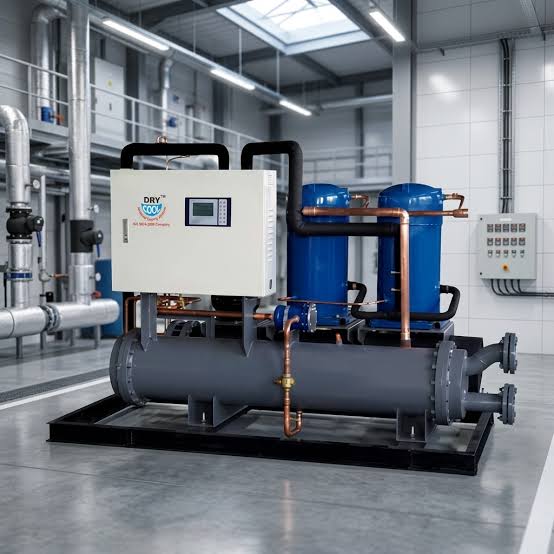
Frequency Inverter (Drive) and Automation Integration in Chiller Systems
In industrial cooling systems, the largest operating cost is the electrical energy consumed by compressors. Systems operating on traditional "On/Off" logic work at full capacity even when cooling demand is low, leading to significant energy waste. Today, modern HVAC and process cooling infrastructures provide capacity control through a much smarter method: frequency inverters (drives).
Why Inverter (Drive) Technology?
Inverter-driven systems continuously adjust the speed of compressor and fan motors according to the instantaneous cooling load of the facility. The main advantages of retrofit or factory-installed drives are as follows:
Maximum Energy Savings: Reducing compressor speed under partial loads provides up to a 40% reduction in power consumption.
Precise Temperature Control: Water or air temperature is maintained at a stable regime without fluctuations.
Low Inrush Current (Soft-Start): Instead of being connected directly to the grid, motors perform a soft start via the drive, thus preventing sudden load spikes in the facility's electrical infrastructure.
Advanced Fault Diagnosis and Digital Parameter Security
Drive integration transforms a mechanical chiller unit into a smart data-generating device. Industrial motor control systems not only adjust speed, but also offer advanced hardware protection.
For instance, instantaneous voltage fluctuations, grid imbalances, or motor phase losses occurring in the system can be pinpointed right from the automation screen. Conducting root cause analysis of such alerts prevents costly compressor burnouts. Furthermore, all calibration settings and operating cycles of the drives can be digitally backed up via industrial communication protocols (Modbus, Profinet, etc.). In the event of a control panel or board failure, transferring this backup to the new hardware allows the system to return to production at its former precision within minutes.
Preventing Mechanical Wear and Tear
Frequent cycling of fixed-speed compressors leads to internal oil return issues and mechanical fatigue. In drive-controlled systems, instead of coming to a complete stop, the compressor continues to operate by slowing down. This smooth operational principle keeps the oil in the compressor crankcase balanced and significantly extends the lifespan of mechanical components.
Mechatronic Solutions with FSI Cooling
Integrating an inverter into a chiller unit or revising the automation of an existing system is not merely connecting a device to an electrical panel; it is a high-level engineering effort where thermodynamic, electrical, and software disciplines work together.
You can contact us to get professional support to strengthen the automation infrastructure of the cooling systems in your facility and maximize energy efficiency.
2. Revised Article: Mechatronic Approach in Cooling Systems: Definitive Solutions for Chronic Faults
Mechatronic Approach in Cooling Systems: Definitive Solutions for Chronic Faults
Today, industrial chiller units have long ceased to be simple machines consisting merely of compressors, condensers, and copper piping. Especially in heavy industrial plants with zero margin for error operating 24/7, such as automotive, plastic injection, and precision food processing, cooling infrastructures have transformed into intelligent systems managed by industrial automation.
This complex structure has also put an end to the traditional logic of "recharging gas and replacing parts" in troubleshooting. Underneath recurring, unresolved (chronic) chiller faults lies not usually the failure of a single component, but incompatibility among mechanical, electronic, and software components. This is precisely where the "Mechatronics Engineering" approach comes into play.
What is the Mechatronic Approach and How Does it Solve Faults?
Mechatronics is the intersection of mechanical engineering, electrical-electronics engineering, and software (control) engineering. When a fault in your system is viewed from a mechatronic perspective, the issue is analyzed simultaneously across three different dimensions:
1. Mechanical Dimension: Thermodynamics and Fluid Dynamics
Is the system constantly giving high-pressure alarms or failing to provide adequate cooling? The mechatronic approach solves the problem not just by changing fans, but by re-evaluating system pressure drops, heat exchanger surface efficiency, and expansion valve mechanical response times according to thermodynamic principles.
2. Electrical-Electronics Dimension: Drive and Hardware Analysis
If your compressor is constantly going into protection mode, the issue might be a hardware power imbalance rather than a mechanical jam. Overcurrent conditions, sensor drifts, or communication dropouts occurring in industrial inverters (drives) or PLC control boards must be detected at the electronic level before damaging the motor. Overlooked voltage asymmetries are definitively diagnosed using electronic oscilloscopes and digital power analyzers.
3. Software and Automation Dimension: Process Control
PLC (Programmable Logic Controller) units, the brains of modern chiller packages, operate on complex algorithms. An incorrectly entered PID (proportional-integral-derivative) control parameter causes the system to fail to reach target temperatures and constantly fluctuate (hunting). In a mechatronic approach, the system's software infrastructure is analyzed in a computer environment to optimize response times. Valve opening/closing speeds and compressor loading scenarios are improved programmatically.
Why Choose FSI Cooling?
Chronic chiller failures not only impose high spare parts costs on businesses, but also undermine production targets by causing continuous downtime. The root cause of a fault could be a mechanical blockage, or it could be a software algorithm misinterpreting a sensor reading.
As FSI Cooling Engineering, we approach the industrial cooling systems in your facility not as mere "machines," but as integrated "mechatronic systems." We perform root cause analysis of failures and provide permanent solutions to your plant by supporting mechanical improvements with software and automation optimizations.
You can contact us to secure your production line and eliminate unresolved issues in your systems with an expert engineering approach.
Engineering support for your system
Contact our team for chiller selection, a maintenance plan or breakdown response.